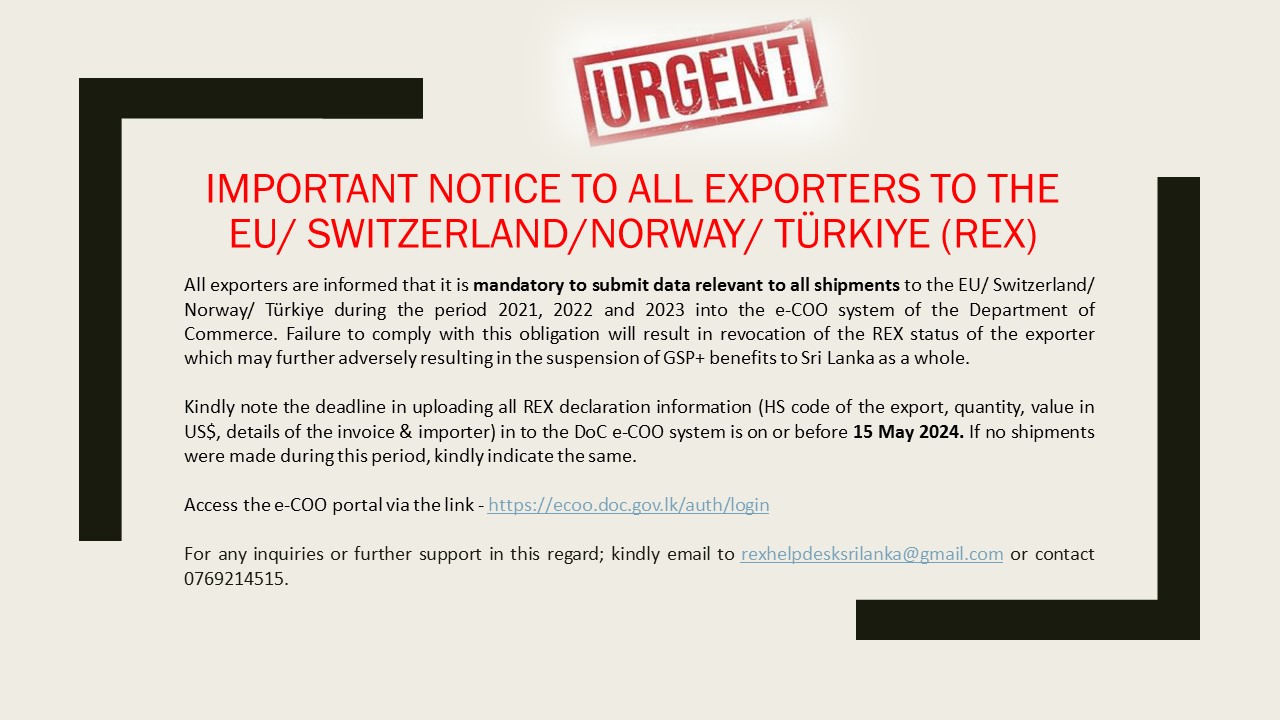

Issuance of Certificate of Origin
You can watch the video on “Digital Signature: Tutorial for Electronic Certificate of Origin” by clicking the link below,
click here
Related Links
 World Trade Organization
 United Nations Conference on Trade and Development
 SAARC Secretariat
 International
Monetary Fund International Trade Centre
 Advisory Centre on WTO Law
 World Intellectual Property Organization
 South Centre
- EU-Sri Lanka Trade-Related Assistance Project
- Facebook Page for EU-Sri Lanka Trade-Related Assistance Project
Department of Commerce
- Details
- Category: Uncategorised
The central pillar of the multilateral rule-based trading system enshrined in the GATT/WTO is the acceptance and operation of the Most Favoured Nation principle. This means that every member of GATT/WTO should invariably accord the same, identical, equal and non-discriminatory treatment to all imports irrespective of the countries of origin.
However, the Generalized System of Preferences (GSP) is an officially agreed exception to the MFN principle which was proposed at the first meeting of the United Nation Conference on Trade and Development (UNCTAD) with a view to assisting the developing countries in their exports and development efforts. In 1964, the First United Nations Conference on Trade and Development (UNCTAD) started to look into ways and means of granting special trade preferences to developing countries.
Main objectives of granting trade preferences to developing countries were :
- To enhance export earnings of developing countries.
- To promote industrialization, and
- To encourage the diversification of their economies.
In 1968, UNCTAD recommended the creation of a "Generalized System of Tariff Preferences" under which industrialized countries would grant autonomous trade preferences to all developing countries.
In order to implement the system a waiver was required from Article 1 of the GATT which prohibits discrimination. This waiver was granted in 1971 by adopting the "enabling clause" of the GATT to create the legal framework for the "Generalized System of Tariff Preferences" (GSP). Under this framework developed countries were authorized to establish individual Generalized Schemes of Tariff Preferences.
The enabling clause was adopted originally for ten years, and renewed in 1979, for an indefinite period of time thereafter.
Countries that Extend GSP Benefits
| Australia Belarus Canada EU* Japan Norway New Zealand Russian Federation Switzerland Turkey USA |
* EU Member States Austria Belgium Bulgaria Croatia Cyprus Czech Republic Denmark Estonia Germany Greece |
Finland France Hungary Ireland Italy Latvia Lithuania Luxembourg Malta Netherlands Poland |
Portugal Romania Slovakia Slovenia Spain Sweden United Kingdom |
- Details
- Category: Uncategorised
The history of the Department of Commerce goes back to 1931, established during the period of British rule to facilitate commercial operations. This government institution was incorporated under the Ceylon State Council Order of 1931, which replaced the Ceylon Legislative Council of 1923. Under the section 32 of the Ceylon State Council Order seven Executive Committees were formed. The Executive Committeeon “Labour, Industry and Commerce” with its legislative powers, created Bureau of Commerce assigned with the subject of “Commerce”. After the independence, with the introduction of a Cabinet System of Government,the same institution now known as the Department of Commerce was assigned to the Ministry of Commerce and Industry on 29thSeptember 1947.
Throughout the years, with its institutional knowledge and capacity, the Department of Commerce has involved in formulation and implementing of Sri Lanka’s foreign trade policies at bilateral, regional and multilateral levels, in close collaboration with relevant line ministries, authorities and private sector stakeholders.
Department of Commerce
No.492
2nd Floor
L. H. P. Building
R.A.de Mel Mawatha
Colombo 03
General No- 2329733/2346114/
2327191/2325524
General COO inquiries- 0778489678
fortrade@doc.gov.lk
011 2430233